I do enjoy a touch of lateral browsing, if that is the correct term for going off on a tangent. I came across the Chinese proverb "The older the ginger the hotter the spice" and I was only checking for the latest football scores. Now, I know that the older ginger is, the more potent it becomes. But the proverb, apparently, means that the older you are, the wiser you become. Well, I had a feeling that was the case.
And here's another old Chinese saying - "Eating radish in winter and ginger in summer keeps the doctor away". I've no idea what it means beyond its literal interpretation.
Here's something you don't see very often on a brewery website - the perfect drink for the designated driver. This is what Waiheke Island Brewery from New Zealand says about its Hauraki Gulf Ginger Beer. This unpasteurised drink is made from juiced ginger, a lot of lemons, raw sugar, honey and plenty of fizz.
Still in New Zealand and news in the Nelson Mail that Moa Brewing will be launching a dry ginger lager sometime this year. Moa Brewing is known for producing bottle conditioned beers in its Marlborough brewery.
Good news last week for Bangladeshi housewives out shopping for ginger in the kitchen markets of Dhaka. Since late last year the retail price of ginger has gone up from Tk40 per kg to Tk90 per kg with the rise being blamed on poor supply. But last week the price dropped dramatically to Tk60-Tk65 per kg. This could have something to do with the fact that the Bangladeshi ginger harvest has now started.
The start of the Bangladeshi ginger harvest was reported by The Financial Express which also mentioned that the bulk of the country's ginger comes from the Nilphamari district in Northern Bangladesh. I've yet to see any reports on the quality and quantity of the new harvest but last September the ginger fields of Nilphamari were hit by a severe virus. Whether this has affected the new crop remains to be seen. As recently as 2008 it was predicted that ginger cultivation in the district could actually cease as disease and virus infection became widespread. The district, which in the past produced enough ginger for the entire country, is still waiting for a consistent supply of virus-free and high yielding ginger seed.
Here is an idea for the UK government. British aid is given to India which has stated that it doesn't want it. So why not buy some virus-free and high yielding ginger 'seed' and give it to the farmers of Nilphamari. You never know, the district could end up supplying the entire country again. And Bangladesh would not have to import from China and India.
The Times of India reported that five people have died in India after drinking a ginger-based ayurvedic medicine containing more than 60% alcohol and sold as an illicit liquor. One of the victims was the retailer of the drink who had been selling it for more than five years.
Cumbria, in North West England, is one of the most sparsely populated counties in the UK. I've often wondered how it managed to produce such a wide range of spiced (including ginger) products, the most famous, I think, being Grasmere Gingerbread. I've now discovered that the small Cumbrian port of Whitehaven was, in the 18th Century, the third largest port in the UK specialising in trade between the Americas and Africa. This trade involved the importation of a range of exotic spices including ginger. It is quite likely that the ginger came from Jamaica which had been exporting since the mid-16th Century.
The Jamaica Information Service announced that the Jamaican government will oversee the expansion of country's ginger and turmeric industries to meet the growing export markets (Whitehaven again perhaps?). The expansion will take the form of 500 extra acres of farmland, more value-added production facilities and extra officials in the agriculture ministry's Export Division. It is interesting to see that after years of inactivity, the Jamaican government has adopted a volte-face and is know actively seeking to rebuild a once internationally famous spice industry. Incidentally, turmeric is a member of the ginger family.
Flavoured tea is becoming popular with tea drinkers in Calcutta, according to The Times of India. Both the young and old have discovered the delights of teas such as fennel & ginger, and ginger, mint & lemon. This is an area in which the West has a lead as flavoured teas have been popular in Europe and the US for a number of years now.
I was speaking to an Indian colleague recently about the mandi markets in India. These are markets where you buy your fruit and vegetables. I had always pronounced it as MAN-DEE but I was wrong. It is actually pronounced MUN-DEE.
Fresh root ginger has become an essential product on the shelves of UK supermarkets. In 2009, Tesco generated sales in excess of £3m on fresh root ginger alone.
Business Standard reported on the difficulties facing Indian spice traders and producers as they grapple with a mass of standards and regulations covering food safety, sustainability and traceability. Countries like Germany, the UK, France, Japan and Australia all insist that Indian exports must adhere to their own standards. But India cannot afford not to meet these standards and regulations as failure could affect the country's position as the largest producer and exporter of spices in the world.
The United Nations Industrial Development Organisation has issued a Request for Proposal (RFP) for the phasing out of methyl bromide in Chinese ginger production. Methyl bromide (also known as bromomethane) is a soil fumigant used as an effective control against nematodes, fungi, insects and weeds. First used in France in the 1930s, methyl bromide is used to control root knot nematodes, pythium soft rot and ginger wilt when applied to ginger cultivation. The use of methyl bromide is being phased out as it is believed that its use damages the ozone layer. Many countries have already phased out use of the pesticide with Japan committing to phase out by 2013.
The Kathmandu Post reported that the Nepalese government is set to take unspecified measures to reduce agricultural imports to ensure better prices for Nepalese farmers. Nepal imported ginger worth Rs176.67 million last year with China accounting for Rs99 million and India Rs72 million. A recent post on the Nepal Spot Exchange blog said that production of ginger in India, the destination of much of Nepal's ginger, has increased in response to Indian government agricultural subsidies. This has forced down the price of Nepalese ginger. The blogger was also critical of the poor state of Nepal's processing and warehousing facilities. So I'm feeling rather confused as to what the Nepalese government is hoping to achieve. Nepal exports a lot of what it produces but its export markets are not as profitable as they once were. But the country cannot retain more of what it produces to replace the imports as it doesn't have adequate storage facilities.

Sunday, 12 February 2012

Sunday, 5 February 2012
Ginger Cocktails, Tchaikovsky, Missing Markets & Gingerbread City
Here is a drink I found this week that sounds quite interesting. It is called Ginger Rootini and is one of the signature cocktails at Om Modern Asian Kitchen in Tuscon, Arizona. Described by the Tuscon Citizen as "a must for ginger lovers", the drink is made by first grating and juicing fresh ginger, and then adding Domaine de Canton (a ginger liqueur), vodka and lime juice. I haven't tried it yet as I don't live in Tucson. And I don't have any Domaine de Canton. And I don't have any vodka either. Still, ginger and lime go nicely together.
Capital, a New York online news publication, introduced me to a fascinating story about Pyotr Ilyich Tchaikovsky and gingerbread. In May of 1891, Tchaikovsky was on his way by train to visit Niagara Falls. During a brief interlude whilst changing trains in Utica, he wrote a letter to his brother, Modest, which contained this extract "ginger bread and toy soldiers have started dancing in my head". The following year these images were presented to the world as the "Dance of the Sugar Plum Fairy" from The Nutcracker.
Next week the 11th World Spice Congress will convene in Pune, India. From February 9-11, over 200 international delegates and over 250 Indian delegates will meet to discuss aspects of spice under this year's theme of "Sustainability and Food Safety: Global Initiatives". The spice industry (and we are including ginger here) has to ensure that it meets the demand for quality products on a consistent basis. Incidentally, no country produces as many different spices as India does.
I never knew until the other day that a mainstay of the family medicine cabinet, gripe water, probably contains ginger. I say "probably" as it depends on which formulation you have bought. And I was surprised to learn that after more than 150 years there is no medical evidence for the effectiveness of gripe water. But it seems to work.
Two of the most pleasing aspects of surfing the Internet, I find, are discovering things I never knew and being able to visit places I've never been to before and not likely to in the future. It was last night that I discovered the existence of the Old City district of Sana'a, the capital of Yemen. I wasn't looking for Sana'a in particular but it was gingerbread that brought it to my attention. The Old City is sometimes referred to as the Gingerbread City as many of the buildings give the appearance of having been built from gingerbread, complete with white icing. There is an impressive photo of these buildings on the UNESCO World Heritage Site website.
Last December Frankie's Olde Soft Drink Company from South Africa complained to the Advertising Standards Authority (ASA) that the South African retailer Woolworths copied Frankie's packaging and flavours for its own branded range of drinks. The plagiarised drinks included Fiery Ginger Beer and Homemade Ginger Beer. Last week the ASA found in favour of Frankie's because Woolworths had copied the phrase "Good Old Fashioned Soft Drinks". The ASA also ruled that “the packaging may not be used again in its current format in future”. Woolworths in South Africa is not associated with the famous F.W.Woolworth organisation.
A couple of weeks ago I commented on the doubling of the retail price of ginger in Dhaka's kitchen markets from Tk40 per kg to Tk80 per kg. Bangladesh's The Daily Sun has now reported that the price has gone up again to TK90 per kg which, according to the newspaper, is "increasing miseries in the people's lives". The price rise is being blamed on increased demand coupled with poor supply.
The previous story links quite nicely to a report in the Manipur Mail. The newspaper reported that ginger farmers in the neighbouring state of Mizoram are giving up ginger cultivation because of a lack of markets to sell their produce. I found it puzzling that Mizoram, the fourth largest ginger producing state in India, cannot sell its ginger when the state borders Bangladesh which, as we have seen, cannot meet demand. Mizoram farmers are claiming that the state government has not shown sufficient interest in ginger agriculture. Can I suggest that a Mizoram state official talks to a Bangladesh government official. The Mizoram government may also be interested to know that imports of Chinese ginger through Chittagong, Bangladesh's biggest seaport, surged in January (see The Financial Express).
Whilst researching the last story I learned that both Mizoram and Manipur are members of the Seven Sisters States, a group of contiguous states stuck out on a limb in north eastern India.
The Daily News in Sri Lanka reported that over 163,000 families in the Kandy district in the centre of the island have benefited from government agricultural assistance. 7,386 kg of ginger seed have been distributed which could produce up to 30 tonnes of usable ginger.
Here's a recipe for ginger champagne I found on the French website 1001 Cocktails. For each person, take 1 cl of vodka, 2 cl of ginger syrup and 10 cl chilled champagne. Then mix and drink. It seems ideal for Valentine's Day. Apparently it is very popular in New York.
Finally, can anyone tell me whether a ginger compress actually works. Research online tells me many things such as how to make one and what ailments it is purported to assist or cure. Personally I don't subscribe to the "releasing stagnating energy" school of thought but I can well believe that it stimulates blood flow.
Capital, a New York online news publication, introduced me to a fascinating story about Pyotr Ilyich Tchaikovsky and gingerbread. In May of 1891, Tchaikovsky was on his way by train to visit Niagara Falls. During a brief interlude whilst changing trains in Utica, he wrote a letter to his brother, Modest, which contained this extract "ginger bread and toy soldiers have started dancing in my head". The following year these images were presented to the world as the "Dance of the Sugar Plum Fairy" from The Nutcracker.
Next week the 11th World Spice Congress will convene in Pune, India. From February 9-11, over 200 international delegates and over 250 Indian delegates will meet to discuss aspects of spice under this year's theme of "Sustainability and Food Safety: Global Initiatives". The spice industry (and we are including ginger here) has to ensure that it meets the demand for quality products on a consistent basis. Incidentally, no country produces as many different spices as India does.
I never knew until the other day that a mainstay of the family medicine cabinet, gripe water, probably contains ginger. I say "probably" as it depends on which formulation you have bought. And I was surprised to learn that after more than 150 years there is no medical evidence for the effectiveness of gripe water. But it seems to work.
Two of the most pleasing aspects of surfing the Internet, I find, are discovering things I never knew and being able to visit places I've never been to before and not likely to in the future. It was last night that I discovered the existence of the Old City district of Sana'a, the capital of Yemen. I wasn't looking for Sana'a in particular but it was gingerbread that brought it to my attention. The Old City is sometimes referred to as the Gingerbread City as many of the buildings give the appearance of having been built from gingerbread, complete with white icing. There is an impressive photo of these buildings on the UNESCO World Heritage Site website.
Last December Frankie's Olde Soft Drink Company from South Africa complained to the Advertising Standards Authority (ASA) that the South African retailer Woolworths copied Frankie's packaging and flavours for its own branded range of drinks. The plagiarised drinks included Fiery Ginger Beer and Homemade Ginger Beer. Last week the ASA found in favour of Frankie's because Woolworths had copied the phrase "Good Old Fashioned Soft Drinks". The ASA also ruled that “the packaging may not be used again in its current format in future”. Woolworths in South Africa is not associated with the famous F.W.Woolworth organisation.
A couple of weeks ago I commented on the doubling of the retail price of ginger in Dhaka's kitchen markets from Tk40 per kg to Tk80 per kg. Bangladesh's The Daily Sun has now reported that the price has gone up again to TK90 per kg which, according to the newspaper, is "increasing miseries in the people's lives". The price rise is being blamed on increased demand coupled with poor supply.
The previous story links quite nicely to a report in the Manipur Mail. The newspaper reported that ginger farmers in the neighbouring state of Mizoram are giving up ginger cultivation because of a lack of markets to sell their produce. I found it puzzling that Mizoram, the fourth largest ginger producing state in India, cannot sell its ginger when the state borders Bangladesh which, as we have seen, cannot meet demand. Mizoram farmers are claiming that the state government has not shown sufficient interest in ginger agriculture. Can I suggest that a Mizoram state official talks to a Bangladesh government official. The Mizoram government may also be interested to know that imports of Chinese ginger through Chittagong, Bangladesh's biggest seaport, surged in January (see The Financial Express).
Whilst researching the last story I learned that both Mizoram and Manipur are members of the Seven Sisters States, a group of contiguous states stuck out on a limb in north eastern India.
The Daily News in Sri Lanka reported that over 163,000 families in the Kandy district in the centre of the island have benefited from government agricultural assistance. 7,386 kg of ginger seed have been distributed which could produce up to 30 tonnes of usable ginger.
Here's a recipe for ginger champagne I found on the French website 1001 Cocktails. For each person, take 1 cl of vodka, 2 cl of ginger syrup and 10 cl chilled champagne. Then mix and drink. It seems ideal for Valentine's Day. Apparently it is very popular in New York.
Finally, can anyone tell me whether a ginger compress actually works. Research online tells me many things such as how to make one and what ailments it is purported to assist or cure. Personally I don't subscribe to the "releasing stagnating energy" school of thought but I can well believe that it stimulates blood flow.
Sunday, 29 January 2012
New Beers & Whisky, Stone's Advert & Healthy Curries
Welcome to the first post of this blog's second year. I hope that you still find this eclectic mix of ginger news and personal comments of interest. Let me know if there is anything else you would like me to cover.
Here's a beer I missed at Christmas - There Is No Santa from those inventive folk at BrewDog from Fraserburgh in Scotland. It was a limited edition seasonal stout brewed with cocoa nibs and ginger stems. Apparently, it has a gingerbread flavour. Did anyone try it?
Occasionally I will mention the launch of a new ginger-infused or flavoured beer from an established brewery (as you can see from the previous story) but I don't believe that I've ever had the opportunity to introduce you to a new ginger-infused beer from a brand new brewery. The Okoboji Brewing Company is so new that it only held its launch party a few days ago. The Sioux City Journal reported that one of the four launch beers was Midwest Charm Farmhouse Ale With Ginger Added. This 6pc abv beer will, according to the brewery website, pair quite unusually with red and white meat, and with fish.

Many of you will have come across old advertisements and thought "they can't say that". Until fairly recently advertising standards were, to be honest, non-existent. But I was surprised to find an old advert for Stone's Original Green Ginger Wine which made the bold claims that it "Increases virility in men" and "Increases sex drive". I can't believe that these claims have ever been medically substantiated. I found this advert on GingerWine.com, a site dedicated to ginger wine. Although the site is full of interesting facts and paraphernalia about ginger wine, unfortunately it does not seem to have been updated for a number of years.
The Mail Online carried an interesting story on why curries are good for you. Most curries contain spices with strong anti-bacterial properties. Ginger, wearing its spice hat, can slow bacterial growth in meat by 25pc. Add that to the corresponding figures of up to 80pc for garlic, cinnamon and cumin and you end up with a range of tasty and healthy curries. Good news for the Indian subcontinent, Southeast Asia and here in the UK where Wikipedia describes curry as an integral part of British cuisine.
The Atlantic reported during the week that The King's Ginger, one of my favourite ginger drinks, is now available in America. This 41pc abv (82 proof in the US) liqueur from Berry Bros & Rudd is made with macerated ginger root. If you haven't tried it yet, treat yourself.
Reed’s Inc., one of the leading ginger soft drink makers in the US, has announced record revenues of $25 million for 2011. According to the press release, the fourth quarter of 2011 marked the 9th consecutive quarter of 20pc-plus growth. I'm not aware of Reed selling its products outside of the US and Canada. With the rapid growth in ginger products around the world I'm sure that the company must have investigated the export potential of its drinks.
It's been a busy week for ginger drink launches and announcements. The Brisbane Times reported that next month will see the launch in Australia of a ginger-infused lager. XXXX Cloudy Ginger Beer has been developed by Lion Nathan, one of Australia's leading alcoholic beverage companies. Brewed to appeal to the more adventurous drinker, the drink uses the popular Summer Bright Lager. The brewer will produce a limited run of 23,000 cases to test the market.
The Digitel reported that Virgil Kaine has recently launched Bourbon & Ginger, a ginger flavoured bourbon whisky. The drink has been developed in Charleston, South Carolina, by infusing two-year-old Kentucky bourbon with natural ginger and a secret blend of exotic ingredients. It is 40pc abv (or 80 proof in the US).
You probably already know this but I've only just found out that the actor Andy Serkis put a lot of strain on his throat and vocal chords when taking the part of Gollum in the Lord Of The Rings trilogy. He countered this by drinking copious quantities of a homemade drink containing honey, lemon and ginger. The drink became known as Gollum Juice.
The Himalayan Times announced that Nepal has selected ginger as one of three projects to represent the country in the WTO/Enhanced Integrated Framework (EIF) Trading Stories scheme. The EIF is a multi-donor programme which encourages what are known as Least Developed Countries to be more active players in global trading markets. The nominated ginger project, "Enhancing Sanitary and Phytosanitary Capacity of Nepalese Ginger Exports Through Public Private Partnership", concentrates on developing ginger added value which is now acknowledged as the best way of maximising income and profit.
A few weeks ago we reported on the call for more ginger farmers in Fiji to help Buderim Ginger, through its Frespac subsidiary, meet its export contracts. Noosa News has now updated the story by reporting that Buderim Ginger is optimistic that it will honour its commitment to export more than 1000 tonnes. Fiji is now an integral part of the Buderim operation, even when Australian domestic production is good.
And finally, Bruce Cost, America's leading authority on ginger, has said of ginger that "It’s probably the premier herb on the planet".
Here's a beer I missed at Christmas - There Is No Santa from those inventive folk at BrewDog from Fraserburgh in Scotland. It was a limited edition seasonal stout brewed with cocoa nibs and ginger stems. Apparently, it has a gingerbread flavour. Did anyone try it?
Occasionally I will mention the launch of a new ginger-infused or flavoured beer from an established brewery (as you can see from the previous story) but I don't believe that I've ever had the opportunity to introduce you to a new ginger-infused beer from a brand new brewery. The Okoboji Brewing Company is so new that it only held its launch party a few days ago. The Sioux City Journal reported that one of the four launch beers was Midwest Charm Farmhouse Ale With Ginger Added. This 6pc abv beer will, according to the brewery website, pair quite unusually with red and white meat, and with fish.
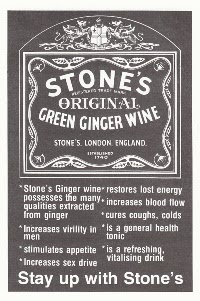
Many of you will have come across old advertisements and thought "they can't say that". Until fairly recently advertising standards were, to be honest, non-existent. But I was surprised to find an old advert for Stone's Original Green Ginger Wine which made the bold claims that it "Increases virility in men" and "Increases sex drive". I can't believe that these claims have ever been medically substantiated. I found this advert on GingerWine.com, a site dedicated to ginger wine. Although the site is full of interesting facts and paraphernalia about ginger wine, unfortunately it does not seem to have been updated for a number of years.
The Mail Online carried an interesting story on why curries are good for you. Most curries contain spices with strong anti-bacterial properties. Ginger, wearing its spice hat, can slow bacterial growth in meat by 25pc. Add that to the corresponding figures of up to 80pc for garlic, cinnamon and cumin and you end up with a range of tasty and healthy curries. Good news for the Indian subcontinent, Southeast Asia and here in the UK where Wikipedia describes curry as an integral part of British cuisine.
The Atlantic reported during the week that The King's Ginger, one of my favourite ginger drinks, is now available in America. This 41pc abv (82 proof in the US) liqueur from Berry Bros & Rudd is made with macerated ginger root. If you haven't tried it yet, treat yourself.
Reed’s Inc., one of the leading ginger soft drink makers in the US, has announced record revenues of $25 million for 2011. According to the press release, the fourth quarter of 2011 marked the 9th consecutive quarter of 20pc-plus growth. I'm not aware of Reed selling its products outside of the US and Canada. With the rapid growth in ginger products around the world I'm sure that the company must have investigated the export potential of its drinks.
It's been a busy week for ginger drink launches and announcements. The Brisbane Times reported that next month will see the launch in Australia of a ginger-infused lager. XXXX Cloudy Ginger Beer has been developed by Lion Nathan, one of Australia's leading alcoholic beverage companies. Brewed to appeal to the more adventurous drinker, the drink uses the popular Summer Bright Lager. The brewer will produce a limited run of 23,000 cases to test the market.
The Digitel reported that Virgil Kaine has recently launched Bourbon & Ginger, a ginger flavoured bourbon whisky. The drink has been developed in Charleston, South Carolina, by infusing two-year-old Kentucky bourbon with natural ginger and a secret blend of exotic ingredients. It is 40pc abv (or 80 proof in the US).
You probably already know this but I've only just found out that the actor Andy Serkis put a lot of strain on his throat and vocal chords when taking the part of Gollum in the Lord Of The Rings trilogy. He countered this by drinking copious quantities of a homemade drink containing honey, lemon and ginger. The drink became known as Gollum Juice.
The Himalayan Times announced that Nepal has selected ginger as one of three projects to represent the country in the WTO/Enhanced Integrated Framework (EIF) Trading Stories scheme. The EIF is a multi-donor programme which encourages what are known as Least Developed Countries to be more active players in global trading markets. The nominated ginger project, "Enhancing Sanitary and Phytosanitary Capacity of Nepalese Ginger Exports Through Public Private Partnership", concentrates on developing ginger added value which is now acknowledged as the best way of maximising income and profit.
A few weeks ago we reported on the call for more ginger farmers in Fiji to help Buderim Ginger, through its Frespac subsidiary, meet its export contracts. Noosa News has now updated the story by reporting that Buderim Ginger is optimistic that it will honour its commitment to export more than 1000 tonnes. Fiji is now an integral part of the Buderim operation, even when Australian domestic production is good.
And finally, Bruce Cost, America's leading authority on ginger, has said of ginger that "It’s probably the premier herb on the planet".
Sunday, 22 January 2012
Korean Ginger, Rhubarb Shortage, Wheat Beer & Indian Workshop
I was pleased to read that ginger features in yet another flavour trends report for 2012. This time it is a honey ginger combination which appears in the top 10 beverage flavours predicted by Bell Flavors & Fragrances. Bell also predicts that Korean, Cajun and Greek will be the emerging cuisines this year. Bell is an international company which supplies flavours, fragrances, botanicals and anything else which stimulates the human senses.
It was only after reading about Bell's predictions that I realised that I didn't know much at all about Korean ginger apart from the fact that ginger is grown on the Korean peninsular. So what have I found this week? Well, ginger features prominently in Korean cuisine which is said to be heavily influenced by Chinese and Japanese dishes. Apparently, more ginger is grown in North Korea than South Korea although I don't know how one can access North Korean agricultural data. But we can see the figures for South Korea from the United Nations' FAOSTAT database on Mongabay. These figures show that during the 1961-2009 period ginger production peaked in 1995 but has dropped quite dramatically since then. Why? That's something for me to find out. South Korea now imports ginger from China.
The fact that ginger is used in Cajun cuisine doesn't come as a surprise as my understanding is that Cajun cooking wouldn't be Cajun without a bit of a 'kick'. And ginger can certainly deliver that. I've never really taken an interest in Greek cuisine so I can't say whether ginger is used or not. But I can say that ginger was used in Ancient Greece. Pedanius Dioscoridesa, a Rome-based Greek physician, pharmacologist and botanist, said that ginger could be used as a digestive aid (as today) and as an antidote to poisoning (don't know about that one).
Good news for ginger farmers in Thailand as Fresh Plaza reported that the annual harvest is well underway and that the price and quality appear to be the best for many years. Thai ginger, which is harvested from December to March, is known for having a mild flavour along with many other Thai herbs and spices. The majority of Thai ginger farms are in the north of the country which escaped the ravages of the recent flooding.
Off to Bangladesh now and the report in Reflection News regarding the rising price of ginger in Dhaka's wholesale and retail kitchen markets. Ginger is now being sold for Tk80 per kg compared to Tk40 per kg just two months ago. The increase is being blamed on a fall in domestic production this season. I get the impression that Bangladesh does not produce enough of its own ginger at the best of times as the country needs to import additional produce from Burma. Incidentally, Bangladeshis tend to use ginger more as a condiment rather than a spice.
Bad news for British ginger lovers last week as The Scotsman reported on the possibility of a shortage of rhubarb this year. I don't know about other countries but in the UK ginger and rhubarb are a match made in heaven. The report said that there is panic in the rhubarb triangle. If you've never heard of it before, the rhubarb triangle is an area in Yorkshire bounded by Bradford, Leeds and Wakefield which is known nationally for producing the finest forced rhubarb. A surrounding low-rising mountain range called The Pennines normally creates the required frosty growing conditions but this winter has been unhelpfully mild so far. So keep your fingers crossed for a sudden plunge in temperature but just in Yorkshire.
The Nashville Post reported a new development at the quirkily named Fat Bottom Brewing. This spring should see the launch of an unfiltered wheat beer infused with ginger. Owner Ben Bredesen said that this currently unnamed beer has "definitely got that ginger spiciness, but the taste is much closer to a pale ale". Ben left the software industry (my previous career as well) to concentrate on brewing full time. I hope Ben doesn't mind me showing you the brewery logo.
Regatta Ginger Beer has been named as the Official Ginger Beer for Quantum Key West 2012, a major sailing event in Florida. I've never tried Regatta Ginger Beer (a thoroughly nice drink, I believe). I've never been to Florida (a thoroughly nice place to visit, I believe). I've never even been sailing (a thoroughly exciting activity, I believe) even though I live by the sea. But I wouldn't mind going to this event (hint, hint).
Nepal is a founding member of SAARC(South Asian Association for Regional Cooperation). This organisation exists to promote collective self-reliance in the fields of economic, technological, social and cultural development. According to The Himalayan Times, Nepal has identified ginger as one of 19 product and services with maximum export potential. Ginger will now have the power of the SAARC trading bloc behind it when looking for new export opportunities.
Anyone who’s anyone in the world of Indian spice attended a one-day spice workshop in Kochi last Friday. Attendees included representatives from the farming community, exporters, traders and scientists. The workshop started from the premise that global demand for spices was increasing and that India must retain its position as world leader in spices. According to The Hindu Business Line the workshop concluded by acknowledging that India must face the challenges posed by a shortage of spices available for export. It continued that the shortfall has been caused by a combination of smaller harvests and quality issues. To combat this the workshop recommended a complete overhaul of the supply chain from researchers and farmers through to exporters and consumers. Five major spices with high export potential were identified - black pepper, cardamom, turmeric, nutmeg and ginger. As we've seen from this blog, the world of ginger exports is extremely competitive. At times it can appear to be so complicated and convoluted.
And to finish this week I would like to wish our Chinese readers a happy and prosperous Chinese New Year.
It was only after reading about Bell's predictions that I realised that I didn't know much at all about Korean ginger apart from the fact that ginger is grown on the Korean peninsular. So what have I found this week? Well, ginger features prominently in Korean cuisine which is said to be heavily influenced by Chinese and Japanese dishes. Apparently, more ginger is grown in North Korea than South Korea although I don't know how one can access North Korean agricultural data. But we can see the figures for South Korea from the United Nations' FAOSTAT database on Mongabay. These figures show that during the 1961-2009 period ginger production peaked in 1995 but has dropped quite dramatically since then. Why? That's something for me to find out. South Korea now imports ginger from China.
The fact that ginger is used in Cajun cuisine doesn't come as a surprise as my understanding is that Cajun cooking wouldn't be Cajun without a bit of a 'kick'. And ginger can certainly deliver that. I've never really taken an interest in Greek cuisine so I can't say whether ginger is used or not. But I can say that ginger was used in Ancient Greece. Pedanius Dioscoridesa, a Rome-based Greek physician, pharmacologist and botanist, said that ginger could be used as a digestive aid (as today) and as an antidote to poisoning (don't know about that one).
Good news for ginger farmers in Thailand as Fresh Plaza reported that the annual harvest is well underway and that the price and quality appear to be the best for many years. Thai ginger, which is harvested from December to March, is known for having a mild flavour along with many other Thai herbs and spices. The majority of Thai ginger farms are in the north of the country which escaped the ravages of the recent flooding.
Off to Bangladesh now and the report in Reflection News regarding the rising price of ginger in Dhaka's wholesale and retail kitchen markets. Ginger is now being sold for Tk80 per kg compared to Tk40 per kg just two months ago. The increase is being blamed on a fall in domestic production this season. I get the impression that Bangladesh does not produce enough of its own ginger at the best of times as the country needs to import additional produce from Burma. Incidentally, Bangladeshis tend to use ginger more as a condiment rather than a spice.
Bad news for British ginger lovers last week as The Scotsman reported on the possibility of a shortage of rhubarb this year. I don't know about other countries but in the UK ginger and rhubarb are a match made in heaven. The report said that there is panic in the rhubarb triangle. If you've never heard of it before, the rhubarb triangle is an area in Yorkshire bounded by Bradford, Leeds and Wakefield which is known nationally for producing the finest forced rhubarb. A surrounding low-rising mountain range called The Pennines normally creates the required frosty growing conditions but this winter has been unhelpfully mild so far. So keep your fingers crossed for a sudden plunge in temperature but just in Yorkshire.

The Nashville Post reported a new development at the quirkily named Fat Bottom Brewing. This spring should see the launch of an unfiltered wheat beer infused with ginger. Owner Ben Bredesen said that this currently unnamed beer has "definitely got that ginger spiciness, but the taste is much closer to a pale ale". Ben left the software industry (my previous career as well) to concentrate on brewing full time. I hope Ben doesn't mind me showing you the brewery logo.
Regatta Ginger Beer has been named as the Official Ginger Beer for Quantum Key West 2012, a major sailing event in Florida. I've never tried Regatta Ginger Beer (a thoroughly nice drink, I believe). I've never been to Florida (a thoroughly nice place to visit, I believe). I've never even been sailing (a thoroughly exciting activity, I believe) even though I live by the sea. But I wouldn't mind going to this event (hint, hint).
Nepal is a founding member of SAARC(South Asian Association for Regional Cooperation). This organisation exists to promote collective self-reliance in the fields of economic, technological, social and cultural development. According to The Himalayan Times, Nepal has identified ginger as one of 19 product and services with maximum export potential. Ginger will now have the power of the SAARC trading bloc behind it when looking for new export opportunities.
Anyone who’s anyone in the world of Indian spice attended a one-day spice workshop in Kochi last Friday. Attendees included representatives from the farming community, exporters, traders and scientists. The workshop started from the premise that global demand for spices was increasing and that India must retain its position as world leader in spices. According to The Hindu Business Line the workshop concluded by acknowledging that India must face the challenges posed by a shortage of spices available for export. It continued that the shortfall has been caused by a combination of smaller harvests and quality issues. To combat this the workshop recommended a complete overhaul of the supply chain from researchers and farmers through to exporters and consumers. Five major spices with high export potential were identified - black pepper, cardamom, turmeric, nutmeg and ginger. As we've seen from this blog, the world of ginger exports is extremely competitive. At times it can appear to be so complicated and convoluted.
And to finish this week I would like to wish our Chinese readers a happy and prosperous Chinese New Year.
Sunday, 15 January 2012
Jamaican Exports, Nigerian Strike, Employment Opportunities & Rapper Feud
Following recent calls from Jamaican politicians and businesses for the local ginger industry to re-discover its former glory, the US ambassador to Jamaica has now added her voice in support. Speaking to the Portland (Jamaica) Chamber of Commerce, Pamela Bridgewater urged Jamaica's ginger producers and exporters to take full advantage of the USA's duty-free import program under both the Caribbean Basin Initiative and the Generalised System of Preferences. The ambassador's speech, reported in The Gleaner, also called for investors to support ginger farmers as the ginger "is of the highest quality in terms of its benefit to individuals, its taste, flavour, and its properties". Jamaican ginger was very popular in the US for much of the last century.
This week's mention of Crabbie's isn't going to be about Crabbie's itself. Marketing Magazine reported that Diageo has relaunched its ginger-flavoured Jeremiah Weed Root Brew to compete with the hugely successful Crabbie’s Alcoholic Ginger Beer. Previously launched late last year in the UK with little fanfare, the 4pc abv bottled beer is said to be best served in a jam (or mason) jar over ice. I can't see that serving suggestion really catching on here in the UK as British drinkers prefer not to dilute their alcohol. It is made from ginger, fruit alcohol, spirit & flavours. Sounds interesting.
Ginger growers everywhere will be keeping a close watch on developments in Nigeria, the third largest exporter of ginger after China and India. The country has been hit by a general strike called by trade unions protesting against the removal of petrol subsidies which has led to a doubling of pump prices. According to agra-net.com, one area particularly badly affected is the export of dried ginger. An inability to export could result in a world shortage of dried ginger which, in turn, would increase the price. An increased price would be of immense benefit to growers in countries such as India who have witnessed a drop in income over the last year.
The potential damage caused by the Nigerian general strike on the ginger industry could be more than just a hiccup. A article last month in Nigerian Best Forum seems to indicate that the ginger industry in the state of Kaduna, Nigeria's ginger heartland, is in a parlous condition following decades of neglect.
Employment opportunities in the ginger industry featured a couple of times last week. The first was the news, reported by The Fiji Times, that Fiji's largest ginger processing company, Frespac, is looking to recruit more ginger farmers to help it meet this year's export commitments. Frespac, a subsidiary of Australia's Buderim Ginger, is targeting the UK, Netherlands, Germany, Australia and New Zealand.
This was followed by the Jamaica Observer story that the recently elected Jamaican government is looking to agriculture to create employment. Ian Hayles, Junior Agriculture and Fisheries minister, said that a number of crops, including ginger, will be given priority attention to attract young people into farming. With Jamaica's desire to become self-sufficient in food and the call to export more ginger to the US, a career in ginger farming seems very attractive.
Today sees the launch of a gelatin-free ginger confection at the Winter Fancy Food Show in San Francisco, California. Ginger Spice Drops have been developed by The Ginger People, America's leading ginger company.
Produce News Daily carried an interesting article on the forthcoming Chinese New Year celebrations and how it is raising interest in Asian cuisine. The article also mentioned that the current Hawaiian ginger crop grown by California-based Christopher Ranch "is looking good". I'm not sure whether Christopher Ranch grows ginger in California but I can see why the company has a presence in Hawaii. Hawaiian ginger has a long harvesting season from December to June. In Hawaii's off-season, ginger is imported from Brazil, Thailand, Costa Rica and Peru. Back in 2007 the company had a problem with Chinese grown ginger containing pesticide residues. Maybe that is the reason why China is now missing from the list of Christopher Ranch's suppliers.
It may sound perverse but I'm sure that there is a good reason for it. Hawaii exports much of its ginger crop to the US but then has to import replacement ginger from Fiji. Discuss.
Over to Toronto in Canada now and an unusual story of rappers and ginger ale. The Star reported a feud between two North American rappers by the name of Drake and Common (I've no idea who they are either). Apparently Common calls Drake "you Canada Dry" on one of his songs, presumably in reference to Drake's penchant for the drink. This reached the Twittersphere like everything else does these days and before long Canada Dry Ginger Ale started trending. It would be interesting to know whether the brand registered a noticeable increase in sales in Canada last week.
I've found the link to last week's report on McCormick's global Flavour Forecast for 2012. I still don't know why it disappeared.
The Bangkok Post business section reported on a call by the honorary chairman of the Federation of Thai Industries' pharmaceutical industry club to reduce the cost of the country's medicine imports. Chernporn Tengamnuay said that by developing a herbal industry would both reduce import costs and create employment in the cultivation sector. He said that over 90pc of the raw materials for Thai medicines are imported. Ginger is now undergoing clinical trials to determine its efficacy in easing joint pain. Thailand already has the advantage of being an established ginger producer.
The problems caused by falling ginger prices in India was highlighted in The Hindu Business Line which showed that the current ginger index (the Indians have a useful index for many crops) is not only lower than a year ago, it is also much lower than 2004-5.
We don't often read about ginger in crime (apart from the occasional pesticide incident) but I found one last week in the Waukesha Patch. The Wisconsin city reported that two drug addicts tried to sell fake marijuana to a police informant in order to feed their heroin habits. The fake marijuana was actually a mixture of ginger and leaves which the addicts hoped the informant would only feel and not see.
A new entry for my list of ginger growing countries - Israel (courtesy of Tekoa Farm).
This week's mention of Crabbie's isn't going to be about Crabbie's itself. Marketing Magazine reported that Diageo has relaunched its ginger-flavoured Jeremiah Weed Root Brew to compete with the hugely successful Crabbie’s Alcoholic Ginger Beer. Previously launched late last year in the UK with little fanfare, the 4pc abv bottled beer is said to be best served in a jam (or mason) jar over ice. I can't see that serving suggestion really catching on here in the UK as British drinkers prefer not to dilute their alcohol. It is made from ginger, fruit alcohol, spirit & flavours. Sounds interesting.
Ginger growers everywhere will be keeping a close watch on developments in Nigeria, the third largest exporter of ginger after China and India. The country has been hit by a general strike called by trade unions protesting against the removal of petrol subsidies which has led to a doubling of pump prices. According to agra-net.com, one area particularly badly affected is the export of dried ginger. An inability to export could result in a world shortage of dried ginger which, in turn, would increase the price. An increased price would be of immense benefit to growers in countries such as India who have witnessed a drop in income over the last year.
The potential damage caused by the Nigerian general strike on the ginger industry could be more than just a hiccup. A article last month in Nigerian Best Forum seems to indicate that the ginger industry in the state of Kaduna, Nigeria's ginger heartland, is in a parlous condition following decades of neglect.
Employment opportunities in the ginger industry featured a couple of times last week. The first was the news, reported by The Fiji Times, that Fiji's largest ginger processing company, Frespac, is looking to recruit more ginger farmers to help it meet this year's export commitments. Frespac, a subsidiary of Australia's Buderim Ginger, is targeting the UK, Netherlands, Germany, Australia and New Zealand.
This was followed by the Jamaica Observer story that the recently elected Jamaican government is looking to agriculture to create employment. Ian Hayles, Junior Agriculture and Fisheries minister, said that a number of crops, including ginger, will be given priority attention to attract young people into farming. With Jamaica's desire to become self-sufficient in food and the call to export more ginger to the US, a career in ginger farming seems very attractive.
Today sees the launch of a gelatin-free ginger confection at the Winter Fancy Food Show in San Francisco, California. Ginger Spice Drops have been developed by The Ginger People, America's leading ginger company.
Produce News Daily carried an interesting article on the forthcoming Chinese New Year celebrations and how it is raising interest in Asian cuisine. The article also mentioned that the current Hawaiian ginger crop grown by California-based Christopher Ranch "is looking good". I'm not sure whether Christopher Ranch grows ginger in California but I can see why the company has a presence in Hawaii. Hawaiian ginger has a long harvesting season from December to June. In Hawaii's off-season, ginger is imported from Brazil, Thailand, Costa Rica and Peru. Back in 2007 the company had a problem with Chinese grown ginger containing pesticide residues. Maybe that is the reason why China is now missing from the list of Christopher Ranch's suppliers.
It may sound perverse but I'm sure that there is a good reason for it. Hawaii exports much of its ginger crop to the US but then has to import replacement ginger from Fiji. Discuss.
Over to Toronto in Canada now and an unusual story of rappers and ginger ale. The Star reported a feud between two North American rappers by the name of Drake and Common (I've no idea who they are either). Apparently Common calls Drake "you Canada Dry" on one of his songs, presumably in reference to Drake's penchant for the drink. This reached the Twittersphere like everything else does these days and before long Canada Dry Ginger Ale started trending. It would be interesting to know whether the brand registered a noticeable increase in sales in Canada last week.
I've found the link to last week's report on McCormick's global Flavour Forecast for 2012. I still don't know why it disappeared.
The Bangkok Post business section reported on a call by the honorary chairman of the Federation of Thai Industries' pharmaceutical industry club to reduce the cost of the country's medicine imports. Chernporn Tengamnuay said that by developing a herbal industry would both reduce import costs and create employment in the cultivation sector. He said that over 90pc of the raw materials for Thai medicines are imported. Ginger is now undergoing clinical trials to determine its efficacy in easing joint pain. Thailand already has the advantage of being an established ginger producer.
The problems caused by falling ginger prices in India was highlighted in The Hindu Business Line which showed that the current ginger index (the Indians have a useful index for many crops) is not only lower than a year ago, it is also much lower than 2004-5.
We don't often read about ginger in crime (apart from the occasional pesticide incident) but I found one last week in the Waukesha Patch. The Wisconsin city reported that two drug addicts tried to sell fake marijuana to a police informant in order to feed their heroin habits. The fake marijuana was actually a mixture of ginger and leaves which the addicts hoped the informant would only feel and not see.
A new entry for my list of ginger growing countries - Israel (courtesy of Tekoa Farm).
Sunday, 8 January 2012
Cold Patent Thwarted, Nepalese Ginger, Oil Price Fall & Taste Test
Well, it didn't take long. When I was writing the first post of the year last week I wondered how long would it be before Crabbie's made an announcement. Just four days later, off licence news reported that Crabbie's Alcoholic Ginger Beer will open a ski lodge at the Outdoors Show at ExCeL London, the international exhibition and convention centre, from January 12-15. Visitors will be able to rest and sample Crabbie's products at the 1950s-inspired lodge.
The Times of India carried the story that India has thwarted an attempt by a British pharmaceutical company to patent the use of ginger as a cold treatment. The company, revealed by IBN Live to be Nicholas John Larkins (I don't know if this is correct), wanted to patent a pharmaceutical composition containing ginger and kutki (the Picrorhiza kurroa rhizome) to treat cough, bronchial asthma and lung diseases. Two august Indian bodies, the Department of Ayush and the Council of Scientific and Industrial Research, responded by presenting texts from the Traditional Knowledge Digital Library showing centuries of evidence that ginger and kutki are traditional remedies. Back to the drawing board.
Last April I reported on the 30-60pc markup which Pakistani retailers charged for their Chinese ginger. Now we read of a similar situation in Nepal where retailers are charging up to 45pc above the wholesale price for products such as ginger compared to the normal 10-15pc markup. The report in Fresh Plaza stated that retailers are blaming rising transportation costs.
I have wondered why Nepal exports most of its own ginger to India but then imports large amounts from China. Is it anything to do with cost or quality? Apparently, the reason is quite straightforward according to one story I've read. Transport links in rural Nepal are so inadequate that it is cheaper to import than it is to bring the produce in from the countryside. About 96pc of ginger imports come from China with the balance from Ethiopia and, surprisingly, India.
Still in Nepal, farmers from the Khotang district are switching to cultivating ginger following an improvement in the transport network, according to The Himalayan Times. As I mentioned previously, ginger is a major export crop.
If you are an importer of Chinese ginger oil you will be pleased to read in agra-net.com that the price has fallen again and is now 21pc lower than the record high set early last year.The versatile oil is used in a wide range of products from food seasoning and condiments to cosmetics, perfumes and medicines.
A report appeared last week featuring the McCormick's global Flavour Forecast for 2012. Pleasingly, one of the 12 entries is a ginger and coconut combination. I can't show you the report as it seems to have disappeared from the hosting website (not mccormick.com). Did I dream it?
Indian farmers, in a desperate bid to make windfall profits, are now adopting a risky monocrop strategy. A report in Business Standard says that farmers are putting all their eggs in one basket and allowing their traditional business instincts to be dictated solely by crop prices and margins. Now, prices and margins are important elements in any business decision but to concentrate on one crop only and then face the vagaries of the weather, pests and international competition does seem to be a little foolhardy.
I know that I'm a little bit late with this news but I thought that you would still like to read it. Buderim Ginger commissioned a survey last year which found that 89pc of Australians ate, snacked, drank or cooked with ginger products. In addition, a third of Australians consumed ginger baked goods or ginger beer at least once a month or cooked with fresh ginger at least once a month. Buderim Ginger said that ginger's versatility was one of the reasons for its success.
The South African news site, iol, conducted a ginger beer taste test and came up with the rather interesting finding that only two of the five beers tested actually contained ginger. It's not just interesting, it's frightening really. So always check the ingredients and go for the real thing. If nothing else, you will be supporting farmers in developing countries.
The Times of India carried the story that India has thwarted an attempt by a British pharmaceutical company to patent the use of ginger as a cold treatment. The company, revealed by IBN Live to be Nicholas John Larkins (I don't know if this is correct), wanted to patent a pharmaceutical composition containing ginger and kutki (the Picrorhiza kurroa rhizome) to treat cough, bronchial asthma and lung diseases. Two august Indian bodies, the Department of Ayush and the Council of Scientific and Industrial Research, responded by presenting texts from the Traditional Knowledge Digital Library showing centuries of evidence that ginger and kutki are traditional remedies. Back to the drawing board.
Last April I reported on the 30-60pc markup which Pakistani retailers charged for their Chinese ginger. Now we read of a similar situation in Nepal where retailers are charging up to 45pc above the wholesale price for products such as ginger compared to the normal 10-15pc markup. The report in Fresh Plaza stated that retailers are blaming rising transportation costs.
I have wondered why Nepal exports most of its own ginger to India but then imports large amounts from China. Is it anything to do with cost or quality? Apparently, the reason is quite straightforward according to one story I've read. Transport links in rural Nepal are so inadequate that it is cheaper to import than it is to bring the produce in from the countryside. About 96pc of ginger imports come from China with the balance from Ethiopia and, surprisingly, India.
Still in Nepal, farmers from the Khotang district are switching to cultivating ginger following an improvement in the transport network, according to The Himalayan Times. As I mentioned previously, ginger is a major export crop.
If you are an importer of Chinese ginger oil you will be pleased to read in agra-net.com that the price has fallen again and is now 21pc lower than the record high set early last year.The versatile oil is used in a wide range of products from food seasoning and condiments to cosmetics, perfumes and medicines.
A report appeared last week featuring the McCormick's global Flavour Forecast for 2012. Pleasingly, one of the 12 entries is a ginger and coconut combination. I can't show you the report as it seems to have disappeared from the hosting website (not mccormick.com). Did I dream it?
Indian farmers, in a desperate bid to make windfall profits, are now adopting a risky monocrop strategy. A report in Business Standard says that farmers are putting all their eggs in one basket and allowing their traditional business instincts to be dictated solely by crop prices and margins. Now, prices and margins are important elements in any business decision but to concentrate on one crop only and then face the vagaries of the weather, pests and international competition does seem to be a little foolhardy.
I know that I'm a little bit late with this news but I thought that you would still like to read it. Buderim Ginger commissioned a survey last year which found that 89pc of Australians ate, snacked, drank or cooked with ginger products. In addition, a third of Australians consumed ginger baked goods or ginger beer at least once a month or cooked with fresh ginger at least once a month. Buderim Ginger said that ginger's versatility was one of the reasons for its success.
The South African news site, iol, conducted a ginger beer taste test and came up with the rather interesting finding that only two of the five beers tested actually contained ginger. It's not just interesting, it's frightening really. So always check the ingredients and go for the real thing. If nothing else, you will be supporting farmers in developing countries.
Sunday, 1 January 2012
Captain Scott, Indian Christmas Beer, Skills Shortage & Ginger Tea
Well, by now everyone must have welcomed in the New Year. I hope that all you have wished and worked for comes to fruition. I'm certainly looking forward with excitement to the coming year. Why? I'll let you know in due course.
The Telegraph revealed the Christmas menu enjoyed by Captain Scott and his team during their doomed 1911-12 attempt to be the first people to reach the South Pole. Although thwarted in their bid by Roald Amundsen, on Christmas Eve 1911 the confident team tucked into horsemeat flavoured with onion and curry powder. This was followed by an arrowroot, cocoa and biscuit hoosh (a thick stew); plum pudding; cocoa with raisins, and finished off with a dessert of caramel and ginger. If you live within easy reach of London, you may be interested in an exhibition commemorating the centenary of the polar explorers attempt which opens at the Natural History Museum on January 20th.
Occasionally I've mentioned about new ginger-spiced beers which seem to be very popular these days, particularly in the UK and USA. So I was pleased to read on livemint.com about an Indian beer brewed with the spices traditionally associated with a Christmas cake. The Biere Club, Bangalore's first craft brewery, has created a Christmas brew, with ginger amongst the ingredients, for the festive season only or until the limited run of 2,000 litres has been sold.
The other day I came across a beer called Old Danish Braggot. This has been brewed with honey and ginger from a recipe dating back to 1700 by the Dansk Mjød A/S brewery in Billund, Denmark. Incidentally, Billund is the home of Lego and well worth a visit. I've since discovered that a braggot is a type of beer made, according to Beer Advocate, by "blending spices and herbs with mead and beer to produce a strong concoction with uncommon flavours". Now there's an excuse to take the family to Legoland.
I'm not a science fiction fan so I apologise if I've discovered something which you already know. Today I read about a collection of books (which I've never read) by the American writer Harry Turtledove (who I've never heard of) which feature aliens, known as The Race, who invade Earth during the Second World War. Apparently, these aliens find ginger so addictive that it has the same effect on them as cocaine does on humans. Can anyone tell me whether ginger features heavily in the stories?
You may remember a couple of recent posts in which I referred to the Indian state of Orissa. Well, on the 1st November 2011 it changed its name to Odisha. I mention this because the following story from Orissadiary.com refers to the new name. Odisha is an important producer of ginger and there is a possibility that the state may run out of ginger farmers. A study by the National Skill Development Corporation (NSDC), an Indian Ministry of Finance quango, has identified a shortage of 2,600,000 skilled workers by 2026 in Odisha alone. The aim of the NSDC is to provide the appropriate training to enable people to either gain employment or become self-employed. One particular area in need of assistance is ginger processing industry and the recently discovered financial benefits of adding value.
I'm sure that I read the other day about another ginger-producing country, Malaysia I believe, and the difficulties it is already facing with a shortage of English-speaking workers. What I did definitely read about Malaysia was an academic study into the chemical variations of three locally grown ginger cultivars. A team from the International Islamic University in Pahang wanted to know whether the previously detected chemical variations could be attributed to genetic factors rather than environmental or intrinsic factors. A metabolic fingerprinting exercise using Gas Chromatography-Mass Spectrometry revealed that the variations were due to genetic effects.
The Kerala state government in India has declared Wayanad an agri crisis area following the recent spate of farmer suicides. This news, briefly reported in IBNLive, also stated that farmers were expected to get assistance and relief.
BBC America carried a personal view of the drinking habits of British people, A New Year’s Guide to British Booze. If you navigate to page five of this ten page gallery you will see an entry for alcoholic ginger beer. I can confirm that alcoholic ginger beers are a big hit here in the UK and I'm sure that there will be more to come this year. And this is in addition to the renaissance in ginger-spiced real ales.
GantDaily.com, from central Pennsylvania, reported the interesting story about the effects of rising sea levels and the consequent saltwater intrusion in Vietnam's fertile Mekong Delta. This has necessitated a major rethink regarding the crops that are grown and simple farming fixes. Oxfam has piloted a small project to help farmers with hardier varieties of watermelons and introduce simple methods to save fresh water. Oxfam has now started a similar project with ginger. I must contact Oxfam for progress on this particular project.
Something that has become quite widespread but which I first picked up on China Daily was the story that Simon Cowell attributes his 'youthful looks' (not my words) to drinking ginger tea all day and a few other things. I can't be bothered to write anymore about this except to say that I'm going to start drinking ginger tea on a regular basis. Just a coincidence, I'm sure!
The Telegraph revealed the Christmas menu enjoyed by Captain Scott and his team during their doomed 1911-12 attempt to be the first people to reach the South Pole. Although thwarted in their bid by Roald Amundsen, on Christmas Eve 1911 the confident team tucked into horsemeat flavoured with onion and curry powder. This was followed by an arrowroot, cocoa and biscuit hoosh (a thick stew); plum pudding; cocoa with raisins, and finished off with a dessert of caramel and ginger. If you live within easy reach of London, you may be interested in an exhibition commemorating the centenary of the polar explorers attempt which opens at the Natural History Museum on January 20th.
Occasionally I've mentioned about new ginger-spiced beers which seem to be very popular these days, particularly in the UK and USA. So I was pleased to read on livemint.com about an Indian beer brewed with the spices traditionally associated with a Christmas cake. The Biere Club, Bangalore's first craft brewery, has created a Christmas brew, with ginger amongst the ingredients, for the festive season only or until the limited run of 2,000 litres has been sold.
The other day I came across a beer called Old Danish Braggot. This has been brewed with honey and ginger from a recipe dating back to 1700 by the Dansk Mjød A/S brewery in Billund, Denmark. Incidentally, Billund is the home of Lego and well worth a visit. I've since discovered that a braggot is a type of beer made, according to Beer Advocate, by "blending spices and herbs with mead and beer to produce a strong concoction with uncommon flavours". Now there's an excuse to take the family to Legoland.
I'm not a science fiction fan so I apologise if I've discovered something which you already know. Today I read about a collection of books (which I've never read) by the American writer Harry Turtledove (who I've never heard of) which feature aliens, known as The Race, who invade Earth during the Second World War. Apparently, these aliens find ginger so addictive that it has the same effect on them as cocaine does on humans. Can anyone tell me whether ginger features heavily in the stories?
You may remember a couple of recent posts in which I referred to the Indian state of Orissa. Well, on the 1st November 2011 it changed its name to Odisha. I mention this because the following story from Orissadiary.com refers to the new name. Odisha is an important producer of ginger and there is a possibility that the state may run out of ginger farmers. A study by the National Skill Development Corporation (NSDC), an Indian Ministry of Finance quango, has identified a shortage of 2,600,000 skilled workers by 2026 in Odisha alone. The aim of the NSDC is to provide the appropriate training to enable people to either gain employment or become self-employed. One particular area in need of assistance is ginger processing industry and the recently discovered financial benefits of adding value.
I'm sure that I read the other day about another ginger-producing country, Malaysia I believe, and the difficulties it is already facing with a shortage of English-speaking workers. What I did definitely read about Malaysia was an academic study into the chemical variations of three locally grown ginger cultivars. A team from the International Islamic University in Pahang wanted to know whether the previously detected chemical variations could be attributed to genetic factors rather than environmental or intrinsic factors. A metabolic fingerprinting exercise using Gas Chromatography-Mass Spectrometry revealed that the variations were due to genetic effects.
The Kerala state government in India has declared Wayanad an agri crisis area following the recent spate of farmer suicides. This news, briefly reported in IBNLive, also stated that farmers were expected to get assistance and relief.
BBC America carried a personal view of the drinking habits of British people, A New Year’s Guide to British Booze. If you navigate to page five of this ten page gallery you will see an entry for alcoholic ginger beer. I can confirm that alcoholic ginger beers are a big hit here in the UK and I'm sure that there will be more to come this year. And this is in addition to the renaissance in ginger-spiced real ales.
GantDaily.com, from central Pennsylvania, reported the interesting story about the effects of rising sea levels and the consequent saltwater intrusion in Vietnam's fertile Mekong Delta. This has necessitated a major rethink regarding the crops that are grown and simple farming fixes. Oxfam has piloted a small project to help farmers with hardier varieties of watermelons and introduce simple methods to save fresh water. Oxfam has now started a similar project with ginger. I must contact Oxfam for progress on this particular project.
Something that has become quite widespread but which I first picked up on China Daily was the story that Simon Cowell attributes his 'youthful looks' (not my words) to drinking ginger tea all day and a few other things. I can't be bothered to write anymore about this except to say that I'm going to start drinking ginger tea on a regular basis. Just a coincidence, I'm sure!
Subscribe to:
Posts (Atom)